


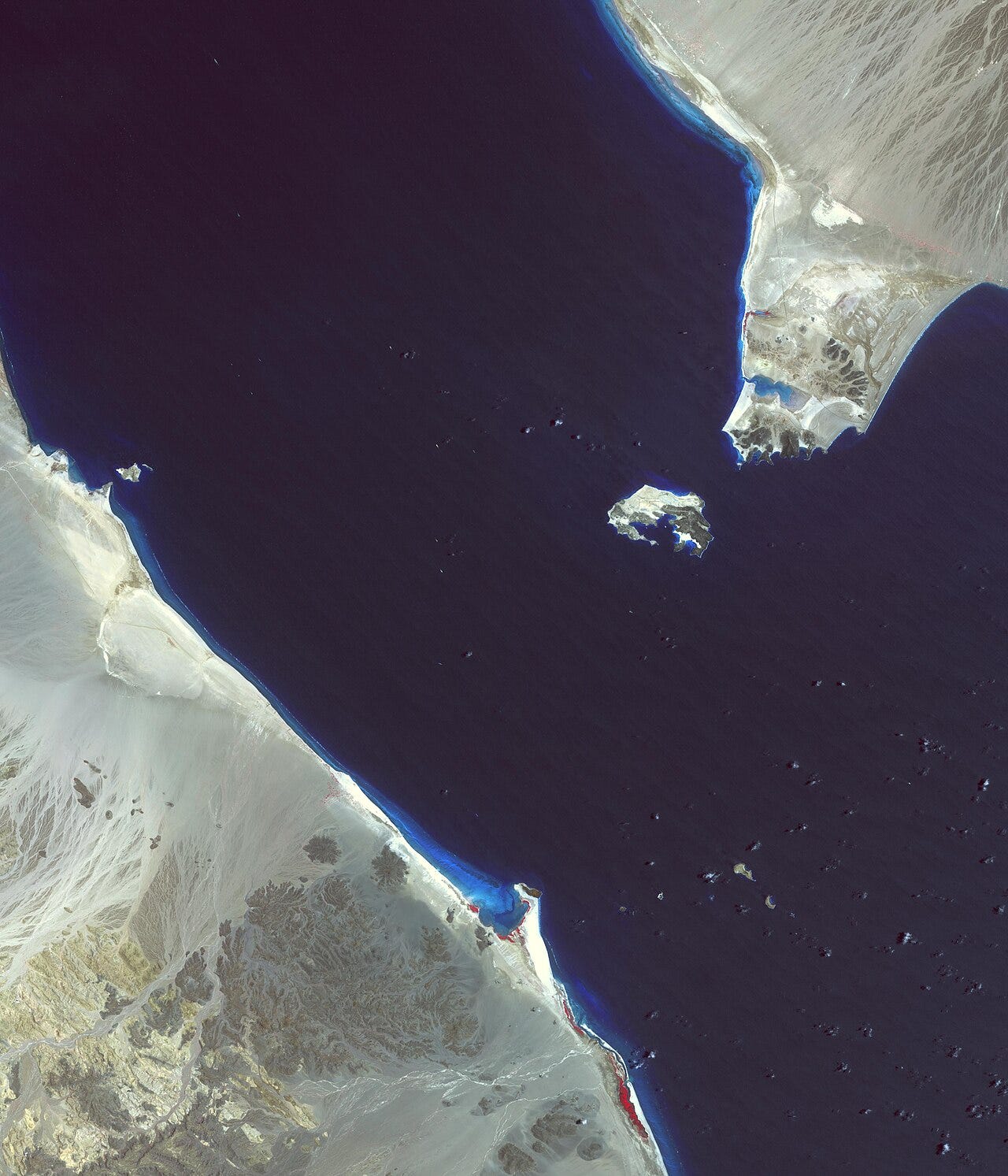
Yemeni Houthis have entered the Iran conflict, vowing to blockade the Red Sea and attack Saudi Arabia. A total blockade has yet to be achieved, but the Houthis have successfully launched attacks on the Saudi oil tankers Rubymar and Tutor (Liberian-flagged), as well as various ports and military targets. Though these attacks drew coalition retaliation against Hodeidah and Kamaran Island, the opening of a new front in an already costly and difficult war only pushes the United States into deeper economic and international chaos.
But a new development indicates a much more long-term and dangerous problem for U.S global primacy: Chinese ships are being uniquely allowed to pass through the Bab el-Mandeb Strait.
Common Anti-Americanism
Since its founding, the Houthi movement has shared a strong anti-American sentiment with various other international players, China later becoming one of them. Though it won’t explicitly call itself so, American protection of Taiwan and alliances with Japan and South Korea (not to mention The Quad, a coalition maintained to counter Chinese influence in the Indo-Pacific) have caused deep rifts in U.S-China relations, and the trade war between the two during Donald Trump’s first presidency did not help.
The common enemy, however, has led to expected alliances. The Iranian government has long backed the Houthis to counter the influence of pro-Western Saudi Arabia, and through Iranian membership in BRICS and flourishing diplomacy with China (on the grounds of countering American influence), Iran-China relations have allowed for a direct pathway to Chinese support for the Houthis. It should be noted that the Chinese explicitly deny backing the group, but U.S intelligence reports consistently find Chinese indirect and tactical support, especially through dual-use drone components that the Houthis use for warfare.
The common anti-Americanism between China and the Houthis has led to a very visible relationship that we are now seeing China reap the benefits of during this war. While American ships are being targeted in the Bab el-Mandeb Strait, a critical passageway for oil shipping, Chinese ships are being allowed to pass through. Aside from preserving Chinese supply chains while disrupting American ones, imbalancing the two competing economies and tipping the scales in favor of China, there is the problem of visibility.
The Chinese Image
Allowing Chinese ships to pass through a warzone where American ships are being attacked is not a first for this war. Earlier in the war, when Iran attempted to blockade the Strait of Hormuz, an Aframax-class oil tanker named Karachi carrying Das crude from Abu Dhabi to Pakistan was given special passage through the guarded region after its shipment was settled in Chinese yuan instead of the typical U.S dollar. While this instance does not signal a total collapse of the petrodollar, it does indicate a significant erosion in trust. The new problem is where that trust is going.
China has now shown that yuan payments can rival the dollar, its ships can pass through warzones incited by the U.S, and that it is not causing active military conflicts worldwide nearly at the same rate as its main rival. When placing all these developments together, a new picture begins to emerge on the world stage. Is China standing where the United States once stood? If so, where is the U.S now?
Beijing has successfully created the image that it is a far more reliable economic partner and anchor for global peace than the United States, and although no major powers have moved in favor of this image just yet, it is evident that numerous smaller nations are enchanted by the idea of a new world order. One that is not held back (in their view) by modern American volatility.
China appears to be successfully positioning itself as the prime alternative to the U.S as the latter spends itself into oblivion. But with Washington becoming more and more unpredictable on the world stage, will it even be able to deter such a threat?